

This week, Anthropic’s historic initial public offering puts the spotlight on how some of the world’s largest companies find their way into stock market indexes. We also examine just how dependent the U.S. economy has become on artificial intelligence investment and why the outlook for inflation and interest rates could prove just as important as earnings growth in determining the market’s direction in 2027.
1. Anthropic’s Historic IPO and the Rules Behind Index Inclusion
Anthropic, the company behind the Claude artificial intelligence platform, priced its initial public offering at $83 per share this week, raising approximately $81 billion and establishing a fully diluted valuation of roughly $1.5 trillion. The transaction is the largest IPO in history and marks a milestone for the AI industry, providing public-market investors with exposure to one of the leading developers of advanced artificial intelligence models.
But the size of the offering raises an interesting question: How does a company worth more than $1 trillion enter the stock market without immediately becoming one of the largest holdings in major stock indexes?
The answer involves something called free float, along with the different rules index providers use to determine when newly public companies become eligible for inclusion.
Although Anthropic’s total valuation is approximately $1.5 trillion, only a portion of its shares will initially be available for public trading. Shares held by founders, employees, and other strategic investors may be restricted or otherwise excluded from an index’s calculation of freely tradable shares. Many indexes therefore base a company’s weight on its float-adjusted market capitalization, rather than its full valuation.
The distinction is meaningful. A hypothetical company worth $1.5 trillion with just 6% of its shares available to public investors would have a float-adjusted market value of approximately $90 billion. That is substantially less than its headline valuation and helps explain why even an enormous IPO may initially have a relatively modest impact on a diversified index portfolio.
Index providers also differ in how quickly they admit newly public companies. These differences mean investors holding seemingly similar index funds could have different exposures to Anthropic for an extended period. As additional shares become available for public trading, the company’s weight in float-adjusted indexes could also change. Index inclusion may create purchases by funds tracking those benchmarks, although the timing and market impact of those flows are uncertain.
Beyond the mechanics of the IPO, Anthropic provides an interesting window into the evolving economics of artificial intelligence. Research from BCA highlights the company’s growing enterprise customer base and the increasing importance of software integrations, recurring contracts, and tools built around its underlying models. In one dataset tracking AI model usage by software developers, Anthropic accounted for just 12.6% of tokens consumed but 46% of spending, suggesting that customers may be paying more for certain advanced capabilities.
These figures illustrate how the economics of AI are evolving beyond simply producing increasingly capable models. They also highlight some of the difficult questions facing the industry, including how much customers will continue paying for premium capabilities as competing models improve.
For investors, the broader lesson from this historic offering is not about predicting Anthropic’s share price. It is about understanding how index construction works, why market capitalization and investable market capitalization can differ substantially, and how the composition of widely followed benchmarks changes as new industries and companies emerge.
 2. Has AI Become Too Important to the U.S. Economy?
Artificial intelligence has been a powerful driver of corporate earnings and stock market returns in recent years. Increasingly, it has also become one of the most important engines of economic growth. That is encouraging in many respects, but the concentration of investment raises questions about what happens when the pace of spending eventually slows.
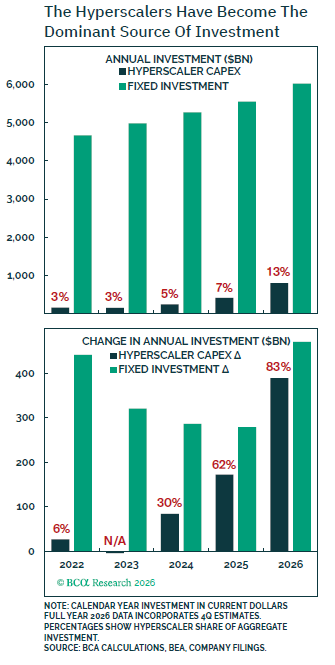
Research from BCA provides a particularly striking perspective. The firm estimates that capital expenditures from the major technology hyperscalers could account for approximately 83% of the increase in aggregate U.S. investment during 2026. Just a few years ago, those companies represented a relatively small portion of incremental investment growth. Today, spending on data centers, computing infrastructure, and the equipment needed to support AI has become a dominant force.
This matters because capital investment has effects well beyond the technology sector. Building new data centers creates demand for construction, electrical equipment, power generation, cooling systems, semiconductor manufacturing, and a wide range of supporting industries. The benefits extend throughout the economy, even if some of the equipment is imported and therefore does not contribute directly to U.S. GDP.
There is also a corresponding vulnerability. When economic growth depends heavily on a relatively small number of companies increasing their investment budgets, a slowdown in that spending can have consequences well beyond those companies’ share prices.
Importantly, spending does not have to collapse for growth to weaken. If a company increases its capital expenditures from $100 billion to $150 billion one year, then holds spending steady at $150 billion the next, investment remains extraordinarily high. But the incremental contribution to spending growth disappears. Multiply that dynamic across several of the world’s largest companies and the economic implications become significant.
BCA believes the current investment cycle can continue supporting economic activity through 2027, although it sees growing uncertainty surrounding spending plans further into the future. Other research providers offer a somewhat different perspective. Alpine Macro argues that moderating capital spending could reduce the risk of excessive investment while leaving the broader economic expansion intact.
The stakes are equally high for corporate earnings. Ned Davis Research estimates that the Information Technology sector will account for more than 80% of the S&P 500’s expected earnings growth in 2027. Semiconductors alone are forecast to make an outsized contribution.
None of this means an AI investment slowdown is inevitable or that the technology’s long-term economic potential is diminished. In fact, advances in efficiency could allow AI adoption to expand even as the cost of delivering those capabilities declines. But economic growth, corporate earnings, and stock market valuations do not always move in lockstep.
The distinction between AI adoption and AI spending is becoming increasingly important. The technology may continue transforming businesses for many years, while the companies building the infrastructure experience a much more traditional capital investment cycle.
For markets, the question heading into 2027 is whether the benefits of AI can broaden across the economy quickly enough to offset an eventual moderation in spending by the companies leading the buildout.
3. The 2027 Outlook: Earnings Growth Meets Higher Interest Rates
As investors begin looking toward 2027, the economic outlook remains relatively constructive, although the combination of moderating growth and stubborn inflation could create a more challenging environment for financial markets.
Ned Davis Research recently published its outlook for the coming year, projecting U.S. real GDP growth of 2.1%, inflation of approximately 3%, and a year-end 10-year Treasury yield of 4.5%. Its baseline expectation is for the economic expansion to continue, but with growth slowing as consumer spending and capital investment moderate.
The inflation outlook is particularly interesting because the underlying picture is more nuanced than the headline numbers suggest.
BCA Research finds little evidence that global inflation pressures are becoming more widespread. Its analysis of the distribution of price changes suggests much of the recent inflation pressure has been concentrated in energy and other supply-related factors, rather than reflecting a broad acceleration throughout the economy.
That is encouraging, but it does not necessarily mean central banks are ready to ease monetary policy. U.S. inflation remains above the Federal Reserve’s target, and policymakers may require more evidence of sustained improvement before changing direction. BCA expects additional rate increases in the near term, while other research providers see a path toward less restrictive policy as inflation pressures eventually moderate.
For the stock market, this creates an important distinction between earnings growth and valuation growth.
One notable development in 2026 has been corporate earnings supporting equity prices even as valuation multiples have contracted. As Strategas highlights in its latest research, strong earnings growth has allowed the S&P 500 to grow into some of its previously elevated valuations.
We believe that is a healthier dynamic than one in which rising stock prices depend entirely on investors paying increasingly higher multiples for the same earnings. Nevertheless, it also means the sustainability of earnings growth becomes especially important.
Interest rates matter in this equation. When Treasury yields remain elevated, investors generally have less incentive to pay exceptionally high prices for future corporate profits. This can be particularly consequential for companies whose valuations depend heavily on earnings expected many years into the future.
At the same time, the economy has shown considerable resilience. Consumer spending continues to hold up despite higher interest rates and energy costs, while the labor market has yet to exhibit the type of widespread deterioration normally associated with recession. Alpine Macro’s latest consumer assessment finds some emerging pressure points, but relatively few serious warning signs.
The potential outcomes for 2027 are therefore quite different depending on how these forces interact. If inflation gradually moderates while earnings continue to grow, markets could benefit from both economic resilience and a less restrictive monetary environment. If inflation remains stubborn or earnings expectations prove too optimistic, elevated interest rates could become a more meaningful headwind.
The key is that a growing economy and a rising stock market are not necessarily the same thing. Starting valuations, interest rates, and the pace of earnings growth all matter.

Bringing It All Together
This week’s developments underscore just how much artificial intelligence has reshaped the investment landscape. Anthropic’s historic IPO illustrates the arrival of a new generation of public companies, while the enormous spending commitments supporting AI have become an increasingly important driver of both economic activity and corporate earnings.
But the broader investment environment remains more complicated than any single technology or company. Inflation, interest rates, consumer spending, and the sustainability of earnings growth will all influence market outcomes in the year ahead.
We continue to see reasons for optimism about the economic expansion, even as the risks associated with concentrated growth and elevated expectations deserve attention. For investors, that reinforces the importance of diversification, discipline, and a portfolio designed to navigate a range of possible outcomes rather than depend on any single market narrative.


