Markets enter the fourth quarter in an unusual spot. Economic growth has been stronger than previously reported, corporate investment remains robust, and inflation data just got a little less threatening. At the same time, interest rates are moving higher, and the stock market has become increasingly dependent on a relatively narrow group of companies tied to the AI investment cycle.
That combination helps explain why investors seem caught between two competing narratives. One says the economy is simply too strong for the Federal Reserve to stop tightening. The other says strong growth and earnings can continue to support markets even with rates higher than investors became accustomed to over the past decade.
For now, we think both stories contain some truth. The economic backdrop remains constructive, but the strength of the expansion is also creating some of the risks investors are watching most closely.
1. Inflation Looks Better, But the Fed Is Not Finished
A significant revision to the Personal Consumption Expenditures inflation data changed the inflation picture this week.
Before the revisions, 12-month annualized core PCE inflation was running at 3.34%, with the six-month rate at 3.46%. Those figures were revised down to 3.01% and 2.74%, respectively (chart below). The historically large gap between PCE and CPI inflation also narrowed substantially.
That matters because some of the inflation strength investors had been reacting to was concentrated in a few categories and was partly a function of methodology. The revised numbers suggest underlying inflation pressure is moderating more than previously believed.
But “better” does not mean “solved.” Core inflation remains above the Fed’s 2% target, and both BCA Research and NDR Research continue to expect another rate increase later this year. NDR characterizes the likely path as hawkish, but not aggressive.
There is also a reason not to become too comfortable with the idea that this tightening cycle will necessarily be brief. Strategas Research Partners notes that the median historical tightening cycle has totaled roughly 300 basis points and lasted about 16 months, although the economic circumstances surrounding each cycle have varied considerably.
 Bottom Line: The inflation news was legitimately encouraging and reduces some of the pressure for aggressive Fed tightening. But with growth resilient and inflation still above target, we believe the most likely path remains additional tightening rather than an immediate end to the cycle.
2. The Market Is Strong at the Top and Weak Underneath
The S&P 500 remains near record highs, but that headline is increasingly hiding what has been happening beneath the surface.
On September 25, the index closed just 0.7% below its all-time high. At the same time, only 24.5% of stocks in NDR’s broad U.S. universe were above their 50-day moving averages, while just 43.1% were above their 200-day moving averages. NDR notes that this combination has never occurred before in data going back to 1981 (chart below).
Another way to see the divergence is through capitalization weighting. While the S&P 500 remains close to its high, the equal-weighted index is nearly 7% below its own peak. During September, Semiconductors and Hardware were essentially the only industry groups generating meaningful gains.
Narrow markets do not automatically mean falling markets. Leadership can remain concentrated for long periods, particularly when the companies leading the market continue to deliver strong earnings growth.
But narrow leadership does make the market more dependent on those leaders continuing to perform.
That is the risk we’re watching as we move into the fourth quarter. NDR still sees a year-end rally as its base case, but a rally that fails to broaden would be a more meaningful warning for 2027.

Bottom Line: The market’s trend remains constructive, but the foundation underneath the major indexes has weakened. A healthier next leg higher would ideally include broader participation beyond the handful of companies currently carrying the indexes.
3. AI Is Becoming an Economic Story, Not Just a Market Story
The AI investment boom increasingly shows up well beyond the performance of technology stocks.
This week’s revisions to the national accounts strengthened that story. First-half real GDP growth was revised from 1.8% to 2.4%, and one of the largest revisions came from private nonresidential investment (chart below). The level of second-quarter private capital expenditure was revised materially higher, with information-processing equipment playing an important role.
Strategas similarly continues to classify capital equipment spending as an economic “asset,” noting that the trend remains very strong even if today’s pace of AI-related investment eventually becomes difficult to sustain.
And BCA estimates that global industrial activity is currently expanding at a strong pace, supported in part by AI-driven demand for capital goods.
The interesting part is that the same force supporting economic growth may also be contributing to some of the market’s biggest risks.
Heavy capital spending supports economic activity and corporate earnings, but stronger growth can also keep inflation and interest rates higher. Meanwhile, in the stock market, AI-related companies have become disproportionately important. NDR finds that Semiconductors have been the single most important industry group explaining daily S&P 500 performance during the past year.
That makes AI both a source of strength and a source of concentration.
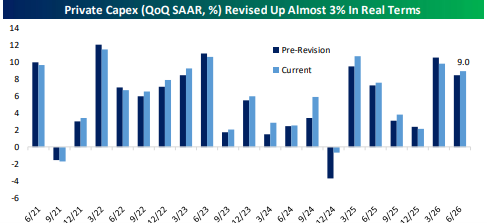
Bottom Line: AI has moved beyond being a simple investment narrative. The buildout is now large enough to influence economic growth, corporate spending, earnings, interest rates, and market leadership. That remains supportive today, but it also means the economy and markets are increasingly sensitive to any slowdown in that investment cycle.
Closing Thoughts
The common thread across all three stories is that the economy and markets still have meaningful support, but some of that strength is becoming increasingly concentrated.
Inflation is moving in the right direction, although not quickly enough to remove the Fed from the equation. Equity indexes remain near record highs, although fewer stocks are participating. The AI capital-spending cycle continues to support growth and earnings, while simultaneously contributing to higher rates and increasingly narrow market leadership.
None of those developments individually argues that the expansion or bull market is ending. But we believe together they reinforce the importance of watching the underlying evidence rather than relying solely on headline index performance. For now, the backdrop remains constructive. The question heading into year-end is whether the strength begins to broaden, or whether investors become even more dependent on the same few economic and market drivers that have carried much of 2026.