The Federal Reserve did something this week it hasn’t done in more than three years. Following the prior cutting cycle, it raised interest rates.
The quarter-point hike itself wasn’t much of a surprise. Markets had largely priced it in beforehand. The more interesting question is why the Fed felt it needed to move at all.
The answer, somewhat strangely, is that things have been pretty good.
Economic growth remains solid. Consumers are still spending. Financial conditions haven’t tightened as much as policymakers might have expected. Unfortunately, inflation hasn’t cooperated either. The Fed acknowledged as much on Wednesday, raising its target rate to 3.75% to 4.00% while noting that domestic spending remains resilient and inflation is still elevated.
So now we have a new wrinkle for investors. The economy is strong enough to handle higher rates, at least for now, but those higher rates raise the bar for just about everything else.
That’s what we’re looking at this week.
1. Why Is the Fed Hiking?
It would be easy to look at the Fed’s decision and conclude that policymakers are suddenly worried about the economy overheating. That’s probably too simple.
Inflation has been stubborn, but the source of that inflation has been changing. Earlier this year, much of the pressure could be traced to supply constraints, including energy and some of the enormous demand created by the AI infrastructure buildout. Lately, there are signs that demand may be playing a bigger role.
Retail sales jumped 1.2% in August, the strongest month in five months. Consumers have continued spending despite higher gasoline prices, softer wage growth, and plenty of complaints about affordability.
There are other signs too. Ned Davis Research notes that domestic nonfinancial debt growth has accelerated to 6.4% (chart below), driven in part by federal borrowing and the enormous capital needs of the hyperscalers. Their broader financial conditions indicator suggests conditions are actually providing a tailwind to economic growth, despite higher Treasury and mortgage rates.
That helps explain the Fed’s thinking.
Chair Kevin Warsh described this week’s hike as removing some accommodation rather than deliberately trying to put the brakes on the economy. That distinction matters. The Fed isn’t responding to a recession. Quite the opposite. Growth has been resilient enough that policymakers apparently believe the economy no longer needs as much help.
And this may not be the last move. Most Fed officials expect at least one more hike this year, although the projections still point to a relatively modest tightening cycle rather than anything resembling 2022.
Bottom Line: The Fed is raising rates because inflation remains too high and the economy has been strong enough to tolerate less accommodation. For now, that’s a very different problem than raising rates into an economy that is already rolling over.

2. A Fed Hike Isn’t Necessarily Good News for Bonds
There is an interesting idea floating around markets right now. The Fed has finally hiked, inflation should eventually cool, and therefore the worst must be over for the bond market.
Maybe. History says we shouldn’t be too quick with that conclusion.
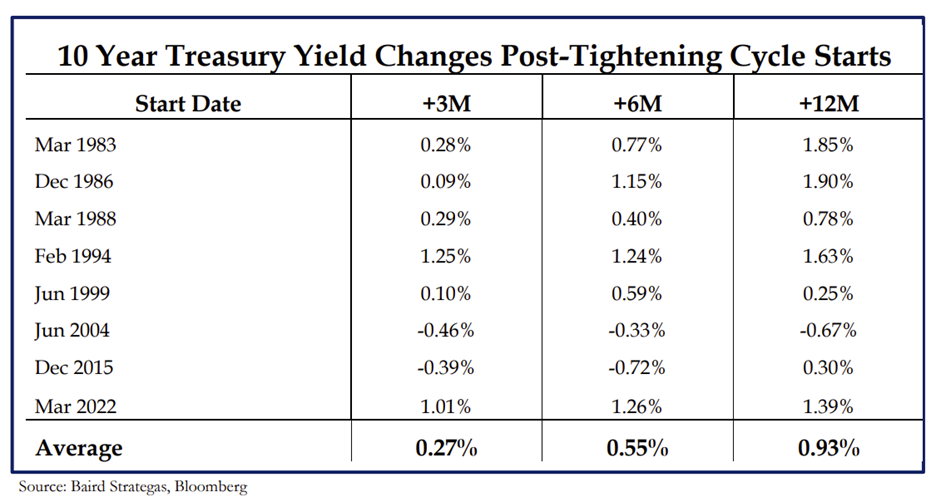
Strategas looked at the eight previous Fed tightening cycles going back to 1983. On average, the 10-year Treasury yield was 0.27 percentage points higher three months after the first hike, 0.55 points higher after six months, and 0.93 points higher after a year (table below). There were exceptions, notably 2004 and 2015, but falling long-term rates following the beginning of a tightening cycle have been the exception rather than the rule.
There’s a fairly intuitive explanation for that.
The Fed controls the overnight rate. It doesn’t control the 10-year Treasury yield. Long-term rates have to incorporate what investors think about future inflation, economic growth, government borrowing, and ultimately how much compensation they require to lend money for a decade.
That distinction feels particularly important today.
BCA Research thinks the Fed is expecting a fairly mild cycle, perhaps another one or two quarter-point hikes. But that forecast depends heavily on core inflation falling next year. If that happens, this could prove to be a short tightening cycle, and we may be getting closer to the peak in longer-term yields. If inflation refuses to cooperate, the calculation changes pretty quickly.
In other words, Wednesday’s hike doesn’t settle the bond debate. If anything, it clarifies what the debate is actually about.
The next 25 basis points probably aren’t the important part. Inflation is. That said, we should acknowledge that the higher rates on bonds are likely to produce better returns going forward if a bond is held to maturity. The nuance of a Fed tightening cycle may mean some more near-term pain for bonds, but the longer-term picture has improved.
Bottom Line: A higher Fed funds rate doesn’t automatically mean long-term yields are about to fall. History suggests the opposite has often happened early in tightening cycles. Where yields go from here will depend much more on whether inflation finally begins moving convincingly lower.
3. Higher Rates Raise the Bar for Stocks Too
Stocks have been remarkably resilient through all of this.
Before the Fed meeting, 2-year Treasury yields had risen 26 basis points in a week, 10-year yields were up 18 basis points and crude oil had jumped more than 5%. Throw in hotter inflation data and a looming Fed hike and you had a pretty decent recipe for a bad week. But the S&P 500 fell just 0.8%.
More importantly, Ned Davis Research notes that the major stock averages remain in uptrends. The parts of its trend work being hurt most by the current environment have been the interest-rate and commodity components, not the stock market itself.
Why have stocks held up?
Earnings are probably a big part of the answer.
Normally, analysts spend a quarter slowly cutting earnings estimates and companies eventually step over the lowered bar. That isn’t happening right now. Strategas notes that third-quarter earnings estimates have actually been revised higher by roughly 1.5%. Positive revisions have considerably outnumbered negative ones.
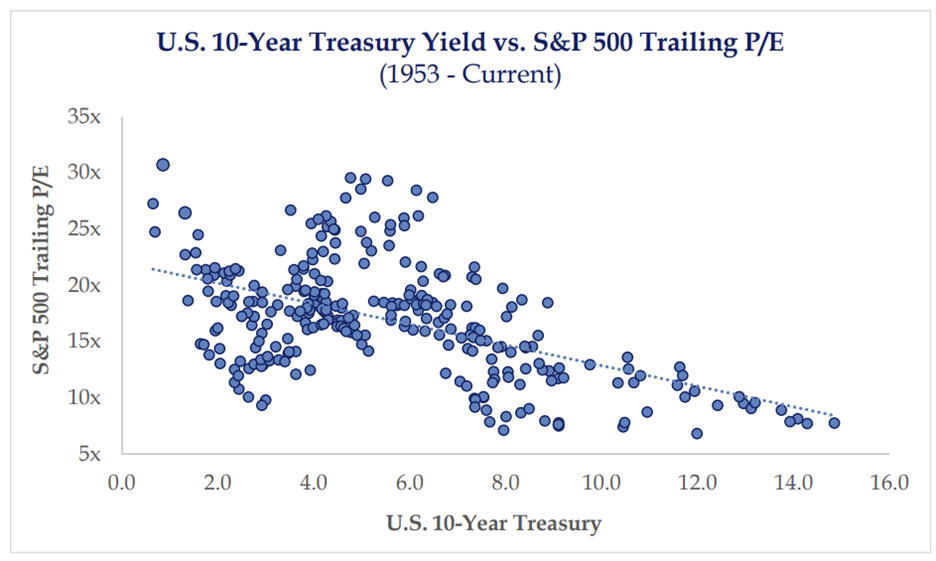
That’s important because higher interest rates create competition for stocks. With the 10-year Treasury yield around 5%, investors have a legitimate alternative to equities, and higher discount rates make expensive valuations harder to justify. Strategas finds that the historical relationship between yields and stock-market multiples, which seemed to disappear for a while, may be reasserting itself (chart below).
That doesn’t mean stocks have to fall because rates went up.
It does mean earnings probably have to do more of the work.
There’s another encouraging piece of evidence here. We wrote several weeks ago about the surge in new stock issuance and the possibility that increasing equity supply could remove one of the bull market’s quieter tailwinds. We now have the other side of that equation.
Despite nearly $100 billion of net new equity supply during the second quarter, NDR calculates that demand for U.S. equities totaled $411 billion. Foreign investors were especially aggressive buyers, while households added another $140 billion. Supply increased. Demand increased even more.
For now, the market has absorbed both higher rates and greater equity supply. We’ll see how long that lasts.
Bottom Line: Higher rates make it harder for valuations to keep expanding, but they don’t automatically end a bull market. As long as earnings continue growing and demand for stocks remains healthy, equities have something to push back against the pressure from rates. The margin for disappointment, however, is getting smaller.
 Closing Thoughts
There’s a temptation whenever the Fed changes direction to make the Fed the entire story.
It rarely is.
Wednesday’s rate hike matters, but mostly because of what it tells us about everything happening around it. The economy has remained resilient. Consumers continue spending. Inflation hasn’t cooled enough. Corporate earnings are still moving higher. Put all of that together, and the Fed decided it could afford to remove some accommodation.
Now comes the harder part.
If inflation cools while growth and earnings remain healthy, a relatively short tightening cycle doesn’t have to be particularly disruptive. If inflation stays sticky, the Fed may have to do more, bond yields could remain elevated and valuations would face considerably more pressure.
We don’t know which path we’ll get yet.
For now, stocks are absorbing higher yields better than you might expect, credit markets outside the lowest-quality borrowers remain relatively calm, and corporate earnings continue to provide fundamental support. Those are all things we’d expect to deteriorate if higher rates were becoming a much bigger problem.
We’ll keep watching them.