Last week, the Fed raised rates for the first time since 2023. This week, the bond market responded. The 10-year Treasury yield climbed to its highest level since 2007, and longer-term yields reached levels most investors have not seen in nearly two decades.
Rates were not the only story. President Xi made his first state visit to Washington in 11 years, and the U.S. and China extended their trade truce as he arrived. And with the midterm elections now about six weeks away, politics is set to play a bigger role in market headlines this fall.
The three stories share a common thread. Each is a source of uncertainty that markets have to work through, and so far stocks have absorbed all of it better than history might suggest. This week we look some of at what pushed yields higher, what the summit may and may not change, and what past midterm cycles can tell us about the months ahead.
1. Bond Yields Climb to Levels Not Seen in Nearly Two Decades
The bond market took center stage this week. On Wednesday, the 10-year Treasury yield rose as high as 5.13%, its highest level since 2007, and it was the biggest one-day jump since April 9, 2025. Longer maturities moved as well, with the 30-year Treasury yield touching 5.446%, a level not seen since June 2004.

Several factors hit at once. A survey showed U.S. business activity rose to a more-than-five-year high in September, pushing yields higher and raising expectations that the Federal Reserve will increase rates at its October meeting. The same day, demand was weak at a $70 billion 5-year Treasury auction, which pushed 5-year yields above 5%. Rebounding oil prices added to inflation concerns. Earlier in the week, the 2-year Treasury note auction drew its highest yield in more than two years at 4.787%, though demand was solid.
This comes just one week after the Fed raised its benchmark rate by 25 basis points to a range of 3.75% to 4.00% and projected one more increase by year-end. Fed officials sounded a similar tone this week, as Philadelphia Fed President Paulson and New York Fed President Williams hinted at more hikes with inflation remaining sticky, and markets are now pricing roughly 60% odds of an October move.
What could this mean for investors? When yields rise, the prices of existing bonds fall, so we expect bond holdings saw some short-term price pressure this week. The other side of that coin is income. Yields for new money in high-quality bonds are now among the most attractive we’ve seen in nearly two decades, and over time, starting yield has historically been a reasonable guide to the returns high-quality bonds have delivered. There are also signs of buyers stepping in. As one strategist noted, buyers appear to be showing up around 5% on the 10-year, which lines up with the prior high set in 2023.
Bottom Line: Stronger economic data, weak demand at a key Treasury auction, and a Fed that may not be done raising rates pushed long-term yields to their highest levels in nearly two decades this week. Higher yields weigh on the prices of existing bonds and raise borrowing costs across the economy, and put pressure on stock valuations because investors can now earn more from safer assets. At the same time, the move reflects an economy that is still running strong. With markets now leaning toward another Fed hike in October, we expect upcoming inflation reports will likely be the biggest driver of where rates go from here.
2. Trump and Xi Meet in Washington
The other major event this week was diplomatic. On Tuesday, the U.S. announced a two-month extension of its trade truce with China, as President Xi Jinping arrived for his first state visit to the U.S. in 11 years. The prior truce had been set to expire on November 10. That timing matters, because the biggest question heading into the summit, whether the truce would be extended, was effectively settled before the two leaders sat down together.
Trump and Xi met at the White House on Thursday for talks covering trade, artificial intelligence, and the war with Iran. The groundwork was laid last weekend, when Treasury Secretary Scott Bessent and China’s top trade negotiator agreed to create a U.S.-China dialogue on AI. Expectations for major breakthroughs were modest, as both sides are focused on keeping the relationship between the world’s two biggest economies stable, with few concrete results expected. Administration officials have said the most important outcome is that the two countries are talking and keeping communication channels open.
This summit is also one stop in a longer process. The two leaders are expected to meet again at the APEC summit in Shenzhen in November and at the G20 summit in Miami in December. For investors, we expect that means U.S.-China relations will likely stay in the headlines through year-end.

Markets leaned optimistic heading into the meeting, with Asian stocks, the Chinese yuan, and Hong Kong equities strengthening in the days beforehand. Bloomberg Intelligence noted that the summit is shrinking the geopolitical discount investors have demanded on Chinese debt and reviving appetite for risk overseas. Trade policy also connects back to the rates story. Lower tariffs or fewer supply restrictions could ease inflation pressure, while new tariffs or tighter export controls could do the opposite.
Bottom Line: The truce extension removes a near-term risk for markets, but it does not resolve the longer-term questions between the world’s two largest economies. Markets have already responded to the calmer tone, and with more leader meetings expected in November and December, we expect the topic will remain in market headlines through year-end. Progress on trade could help ease inflation pressure and support international markets, while any setback, such as new tariffs or tighter export controls, could reverse those gains and add to the inflation concerns already driving interest rates higher.
3. Midterm Elections Are Six Weeks Away
With the midterm elections about six weeks out, we expect politics will play a bigger role in market headlines this fall. On November 3, voters will decide all 435 House seats and 35 Senate seats, with Republicans currently holding narrow majorities in both chambers. The results could shape which policy proposals move forward during the final two years of the current administration.
Midterm years have a reputation for being tough on stocks, and history backs that up. From 1945 through 2025, the S&P 500 averaged a gain of just 3.8% in midterm election years, compared with 10.9% in the other three years of the presidential cycle. Midterm years have also tended to bring deeper pullbacks, which is often attributed to the uncertainty investors face while the outcome is still unknown.
This year has been an exception so far. Through Monday, the S&P 500 was up 13.4% for the year, and its largest pullback was 9.1% on a closing basis, well below the 19% average drawdown in midterm years since 1961. The main reason is earnings. S&P 500 operating earnings grew 32.1% in the second quarter and are expected to rise 25.6% for the full year. Notably, the market’s forward price-to-earnings ratio has fallen about three points this year, which suggests stock prices have been driven by earnings growth rather than investors simply paying more.
That doesn’t mean the calendar is done having its say. Historically, the weakest stretch of a midterm year has tended to bottom around early October, and some choppiness into late October would not be unusual, especially with this week’s rise in interest rates already testing markets.
The more encouraging part of the history comes after the vote. Since 1938, the S&P 500 has posted price gains in the 12 months following a midterm election 95% of the time. One often-cited reason is that markets prefer clarity. Once the results are known, investors can focus on policy direction instead of guessing at possible outcomes. The pattern has also held regardless of which party wins, and economic growth, inflation, interest rates, and corporate earnings have historically influenced markets more consistently than which party controls Congress.
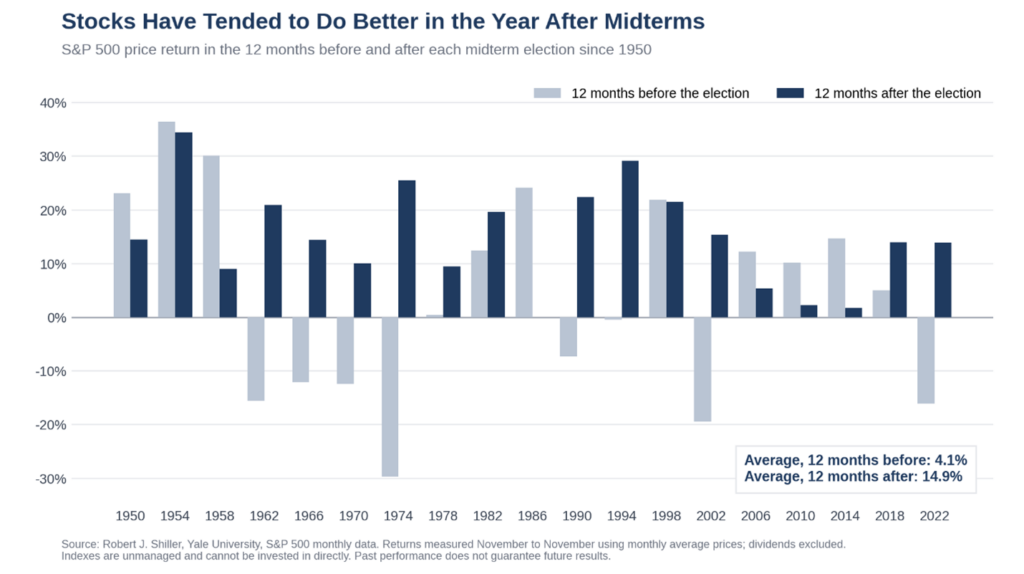
Bottom Line: Midterm years have historically been the weakest stretch of the four-year presidential cycle, but 2026 has held up far better than usual thanks to exceptionally strong earnings growth. The next several weeks have historically been a seasonally soft period, and campaign headlines combined with rising interest rates could add volatility as November 3 approaches. Once the results are in, though, that uncertainty has typically faded, and the 12 months after a midterm election have been one of the more consistently positive periods for stocks. Heading into year-end, we believe earnings, inflation, and interest rates are likely to matter more to markets than the election itself.
Closing Thoughts
Last week the question was how markets would handle a Fed that has started raising rates again. This week the bond market gave its first answer, and it was not a quiet one. Strong economic data and a weak Treasury auction sent long-term yields to levels last seen before the financial crisis, and markets now lean toward another hike in October.
The other two stories are as much about the calendar as the headlines. The trade truce has bought time, and the two leaders are expected to meet twice more before year-end. The midterms arrive November 3, and the weeks leading up to them have historically been some of the choppiest of the cycle. Neither is likely to settle the bigger questions quickly, but elections in particular have a long track record of fading as a source of uncertainty once the votes are counted.
What has held this year together is earnings. S&P 500 earnings are expected to grow more than 25% in 2026, and that growth has carried stocks through a war, an oil shock, and now the highest long-term interest rates in nearly two decades. We believe rates will remain the swing factor heading into year-end, but it is worth remembering that this market has been climbing on fundamentals, not hope.