The Federal Reserve took a break from raising interest rates this week, but that doesn’t mean its work is finished. Inflation remains stubborn, economic growth continues to surprise to the upside, and financial markets are showing signs of stress as investors adjust to higher borrowing costs.
Meanwhile, beneath the surface of the stock market, an unusual amount of rotation is taking place. And as investors debate the near-term outlook, artificial intelligence continues to raise some fascinating questions about the longer-term future of the economy.
Here are three developments that caught our attention this week.
1. The Fed Hits Pause, But Don’t Call It a Pivot
The Federal Reserve left interest rates unchanged this week, keeping its benchmark rate in a range of 3.75% to 4.00%. The decision was widely anticipated, but the message was hardly one of complacency. Two Fed officials favored another rate hike, and the committee upgraded its assessment of economic activity from “solid” to “strong.”
In other words, the economy isn’t giving the Fed much reason to declare victory over inflation.
The challenge is that policymakers are confronting two competing forces. On one hand, inflation remains elevated, with core inflation running around 3%. On the other hand, higher interest rates are already weighing on certain parts of the economy. Housing remains under pressure, credit spreads have widened, and financial conditions have become less accommodative. Raising rates too aggressively could turn an otherwise healthy slowdown into something more serious.
Our research partners generally expect the Fed to resume raising rates in December, although the pace of tightening is likely to remain gradual. BCA Research anticipates two additional quarter-point hikes, while Strategas sees encouraging signs that some inflation pressures may begin easing without the need for aggressive monetary restraint.
Fortunately, the broader economy continues to demonstrate considerable resilience. Consumer spending has held up, business investment remains strong, and recession indicators are still relatively benign. That gives the Fed some room to proceed carefully.
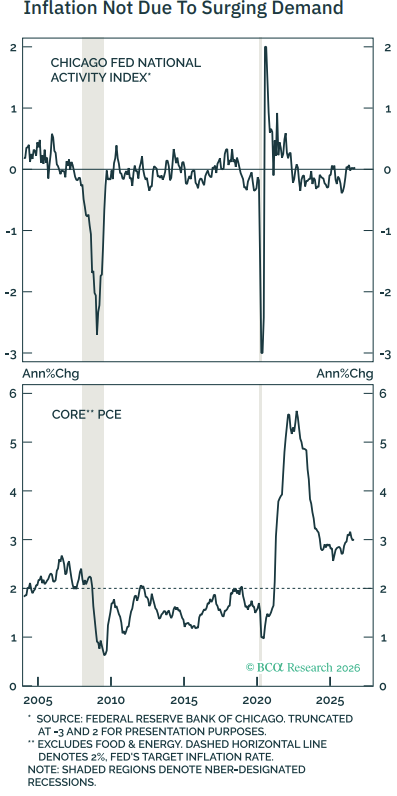 Bottom Line: A pause in rate hikes is not the same thing as a pivot toward easier monetary policy. Higher interest rates may remain a feature of the investment landscape for some time. But a resilient economy and a cautious Fed are a much better combination than an economy sliding toward recession and a central bank scrambling to contain inflation
2. A Market in Rotation, Not Necessarily Retreat
One of the stock market’s more remarkable features this year has been just how frequently leadership has changed. Investors have moved between sectors at a pace rarely seen over the past five decades.
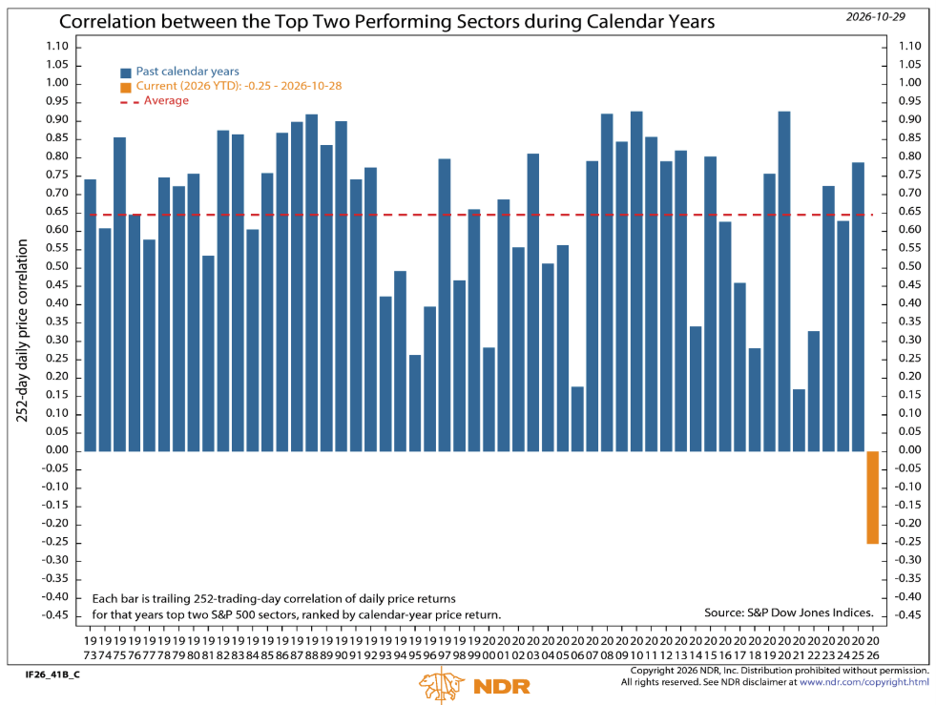
According to Ned Davis Research, 2026 ranks sixth over the past 54 years for the frequency of changes in sector leadership. Even more interesting is the relationship between two of this year’s strongest sectors: Energy and Technology.
Through late October, Energy had gained approximately 53%, while Technology had advanced roughly 26%. Ordinarily, the market’s leading sectors tend to move in the same general direction. This year, however, their correlation has been negative. If that relationship persists through year-end, it would be the first time in NDR’s 54-year study that the two best-performing sectors exhibited a negative annual correlation.
That’s a striking illustration of a market being pulled in different directions.
More recently, weakness in large technology companies and semiconductor stocks has weighed heavily on the major indexes. But the picture beneath the surface has been somewhat more encouraging. Market breadth has improved, suggesting that a greater number of stocks are participating even as some of the market’s largest companies struggle.
There are reasons for caution, of course. Corporate credit spreads have widened, investors are questioning the profitability of enormous AI-related investments, and higher energy prices remain a potential headwind. Still, the recent market action looks more like a changing of the guard than a wholesale deterioration in the economic outlook.
Bottom Line: Market volatility doesn’t always mean the bull market is running out of steam. Sometimes it reflects investors reassessing which companies and sectors offer the most attractive opportunities. Broader participation is encouraging, but we’ll be watching credit markets closely for signs that financial stress is spreading beyond a handful of industries.
3. AI’s Economic Promise Meets Its Investment Reality
Artificial intelligence has dominated the investment conversation for several years now. Most of that discussion has focused on the companies developing AI models, manufacturing semiconductors, and building the data centers needed to support the technology.
But a more interesting question may be what happens if AI actually delivers on its enormous economic promise.
Alpine Macro recently explored the possibility that AI could help solve one of the world’s most persistent economic challenges: declining population growth. For decades, economists have worried that shrinking workforces in developed economies would constrain future growth. If AI allows businesses to produce substantially more with fewer workers, those demographic limits could become far less important.
Taken far enough, the implications are extraordinary. An explosion in productivity could lead to a world capable of producing far more goods and services at dramatically lower costs. That could potentially improve living standards while placing downward pressure on inflation and interest rates.
Of course, getting from today’s AI capabilities to that future is far from guaranteed.
BCA Research offers a useful counterpoint. While enthusiasm for AI continues to accelerate, measurable revenues and productivity improvements haven’t necessarily kept pace. Integrating AI into business operations is more complicated than simply adopting a new software tool. Companies still need to redesign workflows, verify AI-generated output, and determine where the technology can reliably replace or augment human work.
Competition is another consideration. As AI models become more capable and less expensive, the technology may become increasingly commoditized. That would be wonderful for businesses and consumers using AI, but potentially less attractive for companies hoping to maintain extraordinary profit margins.
This creates an interesting paradox. AI could turn out to be one of the most transformative technologies in modern history without every company associated with it becoming a great investment.

Bottom Line: The economic potential of artificial intelligence remains enormous, but technological breakthroughs and investment returns aren’t necessarily the same thing. As the AI revolution progresses, investors will need to distinguish between the companies spending heavily to build the infrastructure, those developing the technology, and those ultimately capturing the economic benefits. History suggests those groups won’t always be the same.