This week, Nick Amat, Senior Portfolio Designer, shares his investment insights for the week ahead.
Last week, we discussed the data that we believed would likely be the catalyst for the Fed’s rate decision. This week, we discuss what could happen if they raise rates. Heading into the September 16 meeting, markets are leaning toward a quarter-point increase, which would be the first hike since the summer of 2023. It would also mark a reversal in the direction of policy after two years spent bringing the target range down from 5.25%-5.50% to the current 3.50%-3.75%.
We believe that record is worth walking through, because the narrative around a first hike tends to be more alarming to investors than the history behind it warrants. The initial move has generally been survivable, and most of the damage in past cycles came from what followed. This week we look at how markets have responded to first hikes, the conditions that would need to hold to keep the advance intact, and where the energy shock is showing up in a way households can feel.
The three stories connect through one channel. Higher energy costs are pushing inflation, inflation is pushing the Fed, and the Fed appears to be the swing factor for markets this year.
1. The First Hike Is Rarely The Problem. The Pace Is.
August producer prices arrived Thursday at 0.4% for the month and 5.4% over the past year, a tenth above expectations. The details mattered more than the headline. Goods prices jumped 1.1%, with over three-quarters of that traced to energy, and diesel alone rose 24.1%. Services rose just 0.1%, and core producer prices came in at 0.2%, below consensus. This was an energy print rather than a broad-based one, which is the distinction that separates an inflation problem the Fed can address from one it cannot. August CPI follows Friday and is the last major reading before the Committee meets.
If the Fed does move, the history is more reassuring than the headlines. Across the eight first hikes since 1983, the S&P 500 gained an average of 5.7% in the following six months, with a median gain of 7.3%. Equities have also tended to rally into the hike rather than away from it, averaging gains of roughly 4% in the three and six months prior.
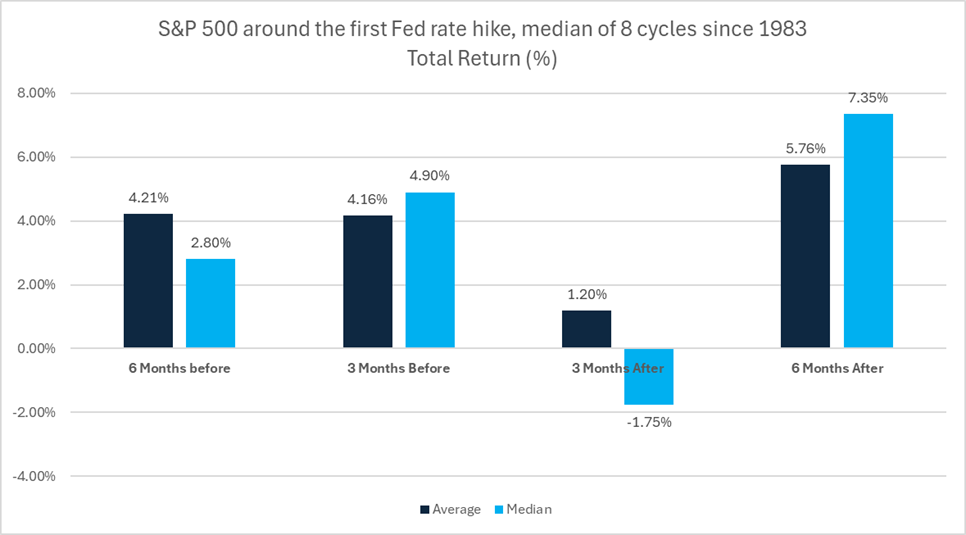
Recent cycles have looked worse in the short run. A three-month decline has followed every first hike since 1994: 3.3% in 1994, 6.2% in 1999, 1.9% in 2004, 1.6% in 2015, and 15.5% in 2022. Markets have become more sensitive to the start of tightening. What has not changed is that those declines have generally reversed within six months. The median six-month return sits above the average, which suggests 2022 did most of the damage.
The more useful cut of the data is by speed rather than by date. Grouping past cycles by how quickly the Fed moved, slow tightening cycles produced an average first-year gain of roughly 10.5%. Fast cycles produced an average first-year loss of about 3.6%. The market does not appear to mind a rate increase. It minds a campaign.
Bottom Line: A first hike is often a repricing event, not a regime change. The 2022 experience distorts how investors think about this, but that was a Fed that was late, forced to catch up, and widely expected to break something on the way. Core producer prices are running at 0.2% a month and wage growth is nowhere near the pace that made post-pandemic inflation persistent, which argues for an adjustment rather than a sustained cycle. The place to look for confirmation is the long end, where last week left off. The 10-year Treasury yield reached 4.84% on Wednesday, its highest since the fall of 2023. If a hike restores credibility, short rates rise while long rates settle. If the 10-year pushes through 5% instead, the market is saying one or two moves will not be enough.
2. What Would Have to Go Right From Here
The market has spent recent weeks in a holding pattern, which is normal for this point on the calendar. September is historically the weakest month for equities, and this one arrived with an unusual number of open questions. The S&P 500 sits near 7,675 and remains up double digits for the year, but the trend and breadth signals supporting the advance have softened. Rather than guess at the outcome, here are the four conditions that we believe would need to hold.
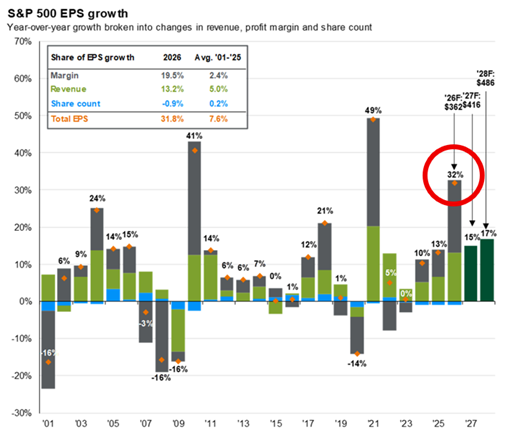
Earnings are the strongest leg. With second-quarter reporting wrapping up, S&P 500 operating earnings growth is tracking near 32% year over year, putting the index on pace for a fourth consecutive year of double-digit gains. That is the main reason the market has absorbed a war, a tariff regime, and an inflation scare without breaking. The honest footnote is that some of it is not repeatable, as tariff refunds and unrealized gains on equity securities turned a good year into an exceptional one.
The Fed is the second, covered above. One or two moves is a condition the market can live with. History would support that a fast cycle is a different story.
Breadth is the third. Despite considerable churn in leadership this year, most stocks remain in longer-term uptrends, with roughly 60% trading above their 200-day moving averages. That is healthy but not commanding. A move below 50% would mark the weakest participation of the year.
Sentiment is the fourth, and it runs counter to intuition. Short-term sentiment sits close to neutral, which is generally a less constructive setup than outright pessimism. A brief dip into pessimism in late July was enough to launch a run to new highs. Rallies build from skepticism, not from the middle.
Bottom Line: This is a checklist, not a forecast. Three of the four conditions are currently intact, and the fourth would improve with a pullback rather than deteriorate. The cross currents are real. Earnings and the underlying economy point one direction, while seasonality, policy uncertainty, and a stalled tape point the other. That combination usually resolves through time rather than a decisive break, which is another way of saying the next several weeks may feel unproductive without actually changing anything. Participation and the pace of policy are what we monitor, not just the daily headlines.
3. The Energy Shock Reaches the American Household
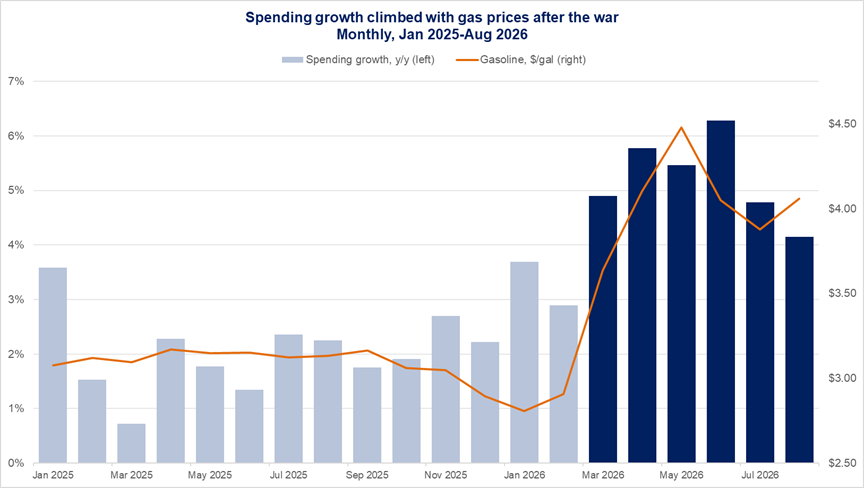
The consumer has been carrying this economy, and the past six months have not changed that. Spending growth is running near 4% year over year, nearly double the pace it was running before the war with Iran began in late February. Discretionary purchases are still driving most of it. Spending picked up after the conflict started rather than slowing.
There is a catch. Gasoline is not really a choice, so when the price at the pump goes up, spending on gas goes up with it. That lifts the overall spending number at the same time it leaves households with less to work with everywhere else. Some of the strength in that near 4% is just people paying nearly a dollar more per gallon for the same tank.
And prices are not easing. Attacks on Saudi energy facilities pushed crude higher on Tuesday, and the U.S. reportedly struck multiple Iranian oil tankers overnight, prompting Iranian strikes on a U.S.-used air base in Jordan. Brent moved back above $100 a barrel, with no clear diplomatic off-ramp in sight.
Much of the world absorbed this months ago. The United States, with more domestic production and a more insulated fuel market, has been slower to feel it, and that gap is closing. Fuel costs also travel further than the pump. Diesel is a direct input for trucking, farming, construction, and freight, so it eventually shows up in the price of anything that has to be moved. Heating season is next.
Bottom Line: Households are weathering this, and the labor market is the reason. With 162,000 jobs added in August and unemployment at 4.1%, paychecks are still coming. But the question here is duration, not resilience. The longer gas stays above $4, the harder it becomes to keep funding the discretionary spending that has held this expansion together, and there is a hint of that in the past two months, with pump prices turning back up while spending growth kept easing. There is an irony worth noting. If consumers do pull back, they will cool the economy without the Fed lifting a finger. That takes some pressure off the Committee, but it is the worst version of tightening, because it comes out of family budgets rather than policy and does nothing to fix the supply problem that caused it.
Closing Thoughts
Last week our question was whether an economy this resilient could absorb an energy shock without letting it settle into prices. This week, the answer arrived in two parts, pointing in opposite directions. Producer prices say the shock is still concentrated in energy. Consumer spending says households have started to feel it anyway.
The Fed appears unwilling to wait for that to resolve on its own, and history suggests that is not the disaster it may feel like on the day. Markets have generally taken a first hike in stride and recovered within a couple of quarters. What they have not tolerated is a Fed that has to keep going. So the thing we are listening for on September 16 is not the decision. It is the language around what follows. A Committee describing an adjustment is a very different signal than one describing a campaign, and the long end will tell you which the market heard.
It has been a year of war, tariffs, and an inflation scare, and corporate earnings are on pace for a fourth straight year of double-digit growth. That is worth remembering the next time a single headline suggests the wheels are coming off.