Financial markets rarely move in straight lines, and neither does the economy. We’ve seen that play out throughout 2026, with stocks navigating rising interest rates, geopolitical uncertainty, and questions about the sustainability of the artificial intelligence boom. Through it all, the economy has continued to expand, and corporate earnings have remained resilient, even as some areas of the market have struggled to keep pace.
As we approach the final months of the year, there are a few interesting developments we believe are worth watching. The midterm elections are just around the corner, some of the powerful forces driving AI-related investment may be showing early signs of moderation, and the relationship between household wealth and economic growth appears to be changing. None of these developments necessarily point to trouble ahead. But they do offer some perspective on the opportunities and risks investors face heading into 2027.
1. Midterm Elections: Will History Repeat Itself?
Election seasons have a way of dominating the headlines, particularly when control of Congress is at stake. And while the political implications can be significant, the relationship between election results and stock market performance isn’t always what people expect.
Historically, the fourth quarter has been the strongest quarter of the year for stocks, with positive S&P 500 returns in 80% of years over the past eight decades. That percentage increases to 85% during midterm election years, suggesting that the removal of political uncertainty has often coincided with improving market performance. Even when the president’s party has lost control of the House, stocks have frequently managed to rally into year-end. The chart below shows this year’s price action in orange overlaid on the historical average market pattern in blue. It is a clear picture of the seasonal tailwind into year-end.
Of course, history doesn’t guarantee anything. This year brings some additional complications, including higher interest rates, a Federal Reserve that has shifted toward tighter monetary policy, and a stock market where leadership remains concentrated in a relatively small number of companies. All of these factors could influence whether the typical seasonal strength materializes. And while investors understandably focus on election outcomes, the direction of earnings and interest rates will likely have a much greater influence on markets over time.
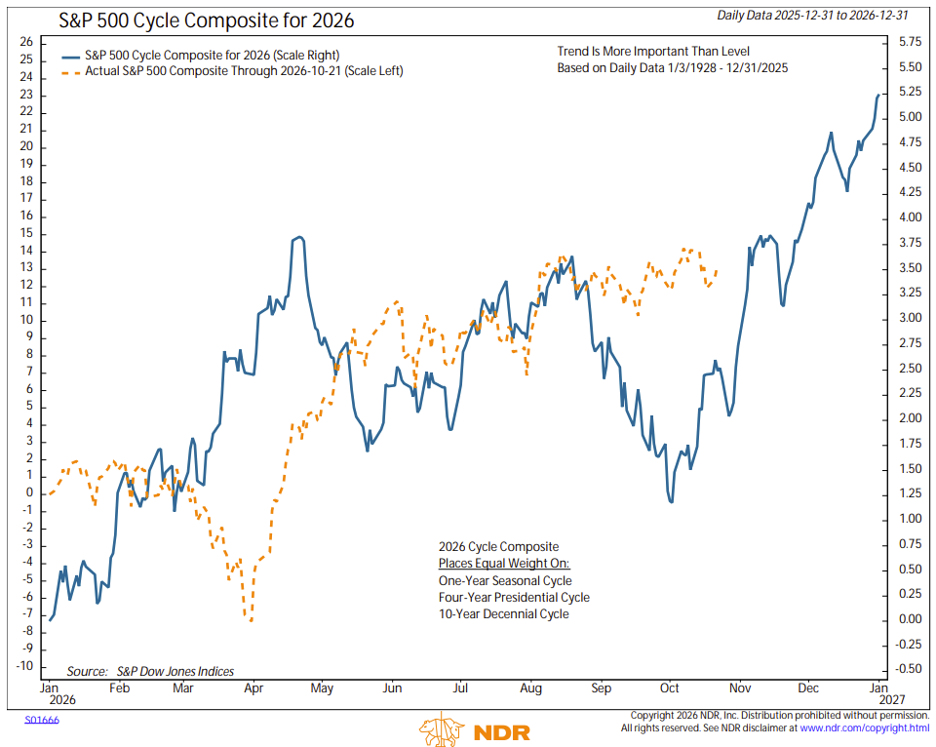 Bottom Line: Elections can create uncertainty, but history suggests they aren’t necessarily an obstacle to positive market returns. The seasonal backdrop heading into year-end is encouraging, though economic fundamentals and monetary policy remain more important to us than which political party controls Congress.
2. Artificial Intelligence: An Inflection Point on the Horizon?
Artificial intelligence has been one of the most important investment themes of the past several years. The enthusiasm has been understandable. Businesses are spending extraordinary amounts of money building data centers, expanding computing capacity, and developing technology that could reshape entire industries. That investment has supported corporate earnings, economic growth, and stock market performance. But even the most promising investment themes experience periods when expectations get ahead of reality.
There are some early indications that the pace of AI-related growth could be moderating. South Korean exports, which provide a useful window into global technology demand, increased nearly 66% during the first 20 days of October compared with the same period last year (chart below). That’s still remarkably strong growth, but it represents a meaningful slowdown from the nearly 90% increase recorded the previous month. Meanwhile, borrowing costs and credit-market indicators are beginning to suggest that financing the enormous amount of planned AI infrastructure may be getting more expensive for certain companies.
That last point is worth emphasizing. Some of the largest technology companies have the financial resources to fund substantial investments through their own cash flows. Others rely much more heavily on borrowing or outside investment. With interest rates elevated, the distinction matters. A project that looks attractive when financing is cheap may look considerably less compelling when the cost of capital rises. And if businesses eventually scale back their investment plans, the effects could extend beyond technology stocks to the broader economy.
None of this suggests artificial intelligence has peaked or that its long-term potential has diminished. In fact, technological adoption could continue for many years. But a transformational technology doesn’t guarantee uninterrupted investment returns, particularly when expectations are already high. We’ve seen that distinction play out before.

Bottom Line: The long-term opportunities surrounding artificial intelligence remain substantial, but investors should distinguish between the technology’s potential and the returns generated by individual investments. With financing conditions becoming more challenging, diversification and selectivity may become increasingly important.
3. Household Wealth: When the Stock Market Influences the Economy
We generally think of the economy as driving the stock market. When businesses grow, profits rise, and investors benefit. But there’s another side to that relationship that has become increasingly important in recent years. The stock market itself may now be having a larger influence on economic activity than at any point in the past.
According to research from BCA, household net worth recently exceeded eight times annual disposable income, an all-time high. Stock investments have become a much larger component of household wealth, thanks to decades of strong market returns. That has created a powerful wealth effect, where rising investment balances give consumers greater confidence and flexibility to spend. In fact, since the beginning of the current economic cycle, inflation-adjusted consumer spending has grown about half a percentage point faster annually than disposable income.
This helps explain one of the more surprising features of the current economy. Despite elevated borrowing costs, persistent inflation, and a somewhat softer labor market, consumer spending has held up remarkably well. Rising home values and investment portfolios have provided an important financial cushion. There are other factors at work too, including relatively healthy corporate profits and increased government transfer payments, but growth in household wealth appears to be playing a meaningful role.
The other side of the equation is less comforting. Just as rising stock prices can support consumer spending, a sustained market decline could eventually weigh on it. And with households holding so much of their wealth in financial assets, that relationship may be more pronounced than in previous economic cycles. It doesn’t mean a market correction would automatically lead to a recession, but it does suggest that the traditional relationship between the economy and financial markets has become more interconnected.

Bottom Line: Rising household wealth has helped support the economy through a challenging period, and that remains an important source of resilience. But greater reliance on appreciating financial assets also introduces vulnerabilities. The economy influences financial markets, and increasingly, financial markets influence the economy.
Closing Thoughts
There are plenty of reasons for investors to remain constructive as we head toward year-end. Corporate earnings continue to grow, the labor market has avoided the deterioration typically associated with recessions, and the economy has demonstrated an ability to absorb higher interest rates. At the same time, some of the forces supporting the expansion are evolving, creating uncertainty about what comes next. So, while it makes sense to monitor these developments, it is equally important not to confuse changing conditions with an inevitable change in direction. Markets have always faced uncertainty, and maintaining a diversified, long-term approach remains one of the better ways to navigate it.