Markets have had plenty to digest over the past few weeks. A surprisingly weak jobs report raised questions about the economy, inflation remains above the Federal Reserve’s 2% target, and stocks are once again trading near record highs. Yet, underneath those headlines, the evidence has generally remained supportive.
This week, we look at three important pieces of that evidence: the inflation trend, another strong earnings season, and one area where we’d still like to see improvement, the breadth of the stock market rally.
1. Inflation Remains a Tailwind
Another week, another inflation report. July’s Consumer Price Index (CPI) increased 0.1%, bringing the year-over-year inflation rate down slightly to 3.4%. Core inflation, which excludes food and energy, rose 0.2% and now stands at 2.5%. Producer prices provided another encouraging data point on Thursday, coming in flat for July compared with expectations for a 0.2% increase.
Is inflation still too high for the Fed’s liking? Probably. But investors may be asking the wrong question.
The chart below looks at inflation a little differently, comparing the current rate with its average over the previous five years. At 3.4%, CPI is now 1.1 percentage points below its five-year average of 4.5%. Historically, falling inflation has been a pretty good backdrop for stocks. When CPI has been at least 0.5 percentage points below its five-year average, the S&P 500 has gained 14.8% per year. That compares with a 9.6% annualized return across the full history of the study.
There will undoubtedly be bumps along the way, and inflation doesn’t need to fall in a straight line. But after spending much of 2021 and 2022 worrying about rapidly rising inflation, today’s environment looks quite different. The direction of travel matters.
Bottom Line: Inflation remains above the Fed’s target, but it continues to move in the right direction. Historically, that has been a tailwind for stocks.

2. Don’t Discount the Earnings Story
We’ve spent plenty of time discussing the impressive corporate earnings backdrop, and the second quarter has given us little reason to change our tune. With 86% of S&P 500 companies having reported, 84% have exceeded analyst estimates. Even better, strong results haven’t been confined to the largest technology companies. Beat rates among mid- and small-cap companies are also near record highs outside of the COVID period.
There is, however, an interesting wrinkle in the numbers.
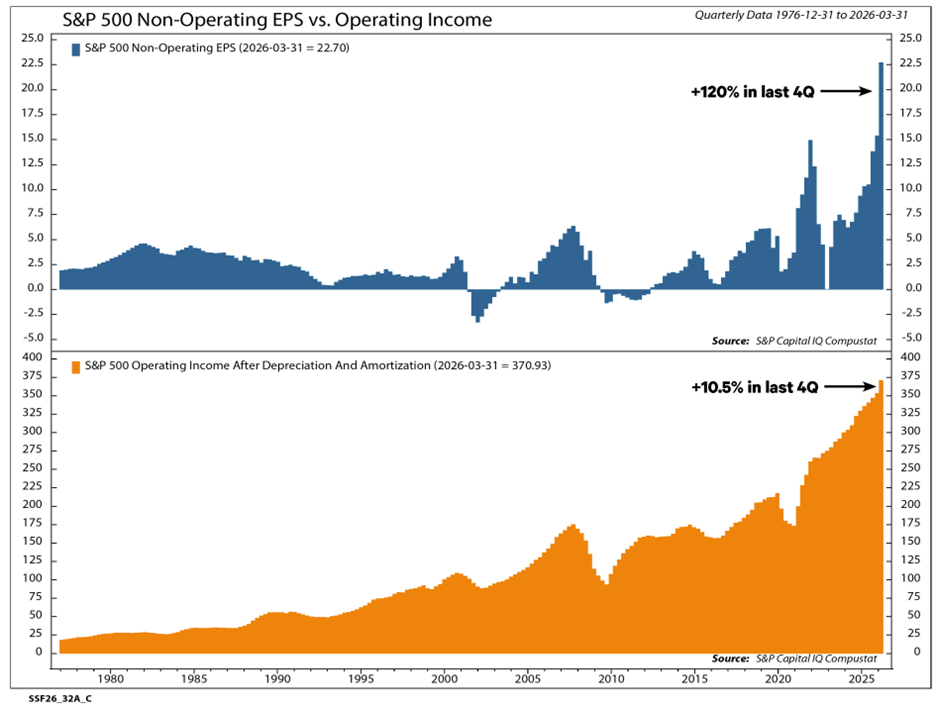
Non-operating earnings have exploded higher, partly because several large companies have benefited from gains on investments in AI-related businesses. Non-operating S&P 500 earnings reached a record $22.70 per share over the four quarters ending in Q1, up 120% from the prior year. The Magnificent Seven alone generated about as much non-operating income as the other 493 companies in the S&P 500 combined.
That certainly makes the headline earnings numbers look better. Does it mean the earnings boom is mostly smoke and mirrors? We don’t think so.
Operating profits have continued to grow as well, while earnings estimates are moving higher as companies report. Consensus estimates for second-quarter S&P 500 earnings have increased by 4.5% during earnings season. That is an important distinction. If stock prices are going to remain near record highs, eventually earnings need to justify them. So far, Corporate America continues to deliver.
Bottom Line: “Paper gains” are providing an unusual boost to profits, but they don’t explain away the strength in earnings. The underlying fundamental backdrop remains solid.
Source: NDR Research
3. New Highs Are Good. Broad New Highs Are Better.
The S&P 500 and several other major indexes have recently traded at record highs. We’ve written about this before, but it is worth repeating: record highs are not, by themselves, bearish. Bull markets spend a lot of time making new highs.
Still, we’d like to see more stocks join the party.
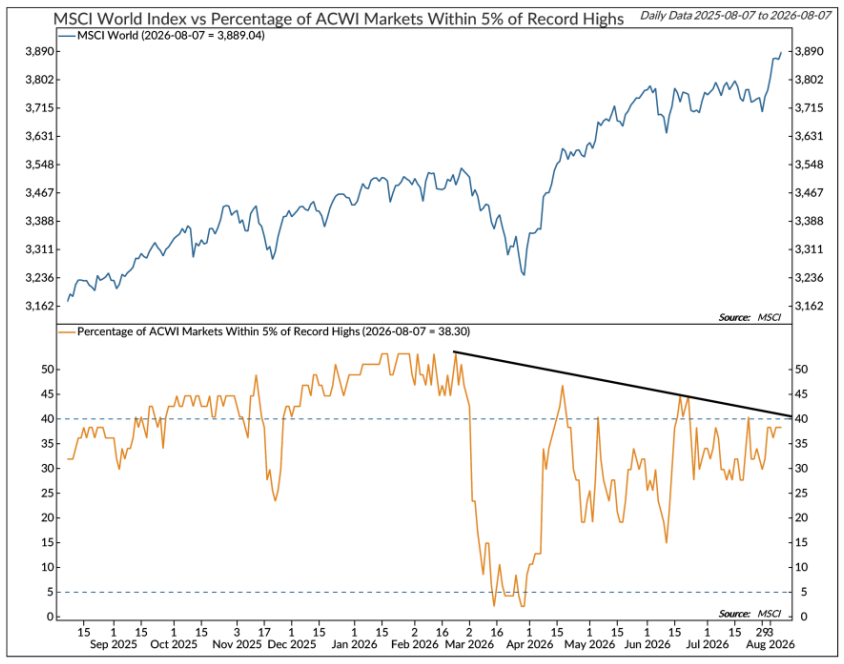
Only about one-quarter of the 47 countries represented in the MSCI All Country World Index have reached one-year highs. Slightly more than one-third are even within 5% of doing so. The same issue exists closer to home. Financials and Industrials have joined the S&P 500 at record highs, but most other sectors have yet to confirm the move.
Does that mean the bull market is in trouble? Not necessarily. Markets can advance for quite some time with a relatively small number of stocks doing much of the heavy lifting. But we’d feel better about the latest highs if participation began to broaden.
Think about it this way: if the S&P 500 is making new highs while more sectors and individual stocks are doing the same, there are simply more engines powering the advance. Right now, some of those engines haven’t kicked in.
Bottom Line: The trend in stocks remains positive, but participation has been narrower than we’d prefer. Broader leadership would give us greater confidence in the next leg of the bull market.
Source: NDR Research
Closing Thoughts
There is an old saying that bull markets climb a wall of worry. Investors have certainly had plenty to worry about this year. Geopolitical conflict, tariffs, inflation, a weak jobs report, and elevated valuations have all taken their turn in the headlines. Through it all, stocks have continued to advance.
Why? We think the answer is relatively straightforward. The evidence has generally been better than the headlines.
Inflation is moving in the right direction. Earnings continue to grow and beat expectations. Economic data outside of the recent payroll report have shown few signs of distress. That doesn’t mean risks have disappeared, and narrow market breadth is one reason we aren’t ignoring them.
For now, though, we believe the weight of the evidence remains favorable. As always, we’ll let that evidence, not the headlines, guide our outlook.