Markets have had plenty to digest lately, but three stories stand out to us this week.
The first is happening in the bond market, where long-term Treasury yields moved back toward levels we haven’t seen in nearly two decades and prompted a response from the Treasury Department. The second involves artificial intelligence. The AI spending boom has been one of the defining forces behind economic growth and corporate earnings, but eventually that investment has to generate a return. And finally, despite higher rates, softer employment data, and plenty of reasons to worry, the broader economy continues to hold together reasonably well.
Taken together, it is a good reminder that markets rarely turn on a single data point. What matters is how the pieces fit together.
1. The Bond Market Pushes Back
Long-term interest rates became one of the biggest stories in markets this week.
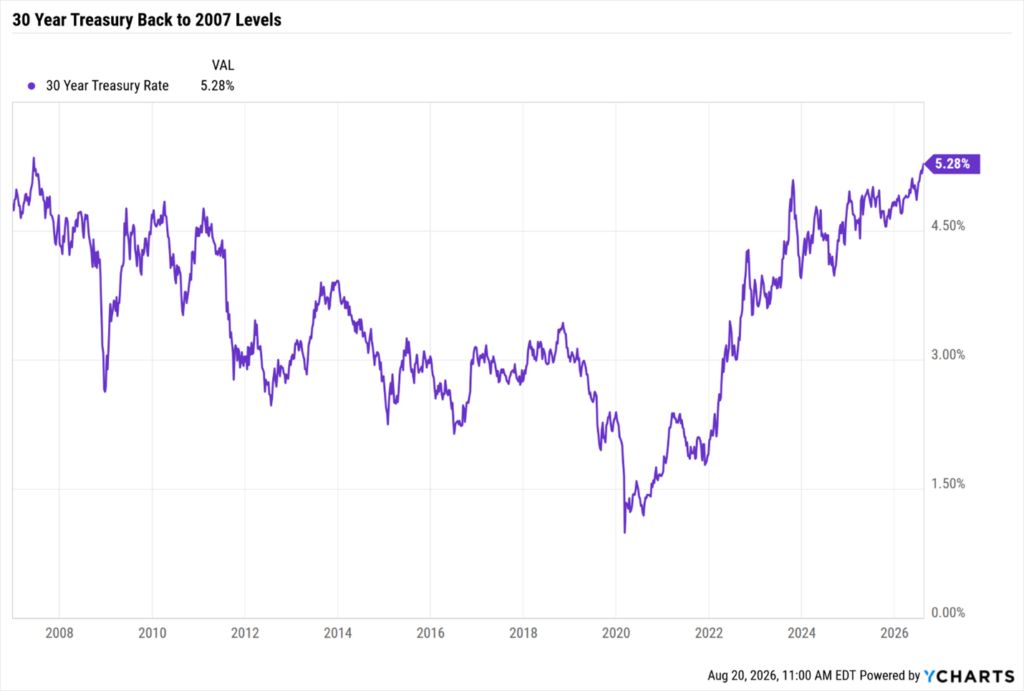
The 30-year Treasury yield briefly reached roughly 5.3% (chart below), its highest level since 2007. In response, the Treasury Department announced that it would at least double the size of planned buybacks of longer-dated Treasury securities, increasing purchases of 10- to 30-year bonds from $2 billion to at least $4 billion per operation. Bond yields fell following the announcement.
There is an important distinction here. Treasury is not embarking on a new quantitative easing program. The buyback program is primarily intended to improve liquidity in older Treasury securities, and even the increased purchases are quite small relative to the overall Treasury market. Still, the timing caught our attention.
The federal government is asking investors to absorb an enormous amount of debt at the same time that the Federal Reserve is no longer acting as the marginal buyer it once was. BCA Research notes that the Fed purchased 46% of net Treasury issuance between 2020 and 2022. From 2023 through 2025, it became a net seller, leaving investment funds and other private investors to absorb much more of the supply.
Private investors ultimately have a price. If they become less comfortable with inflation, fiscal policy, or the amount of debt coming to market, they can demand a higher yield to own it.
Interestingly, BCA argues that we still haven’t seen much of a true fiscal risk premium embedded in Treasury yields. Their concern is that this may not last forever as rising interest expense consumes more government revenue and debt continues to accumulate.
We don’t need to embrace the more dramatic “bond vigilante” forecasts to appreciate the message. For much of the past 15 years, policymakers could operate against the backdrop of extraordinarily low interest rates. That is no longer the world we live in.
Bottom Line: The rise in long-term yields isn’t a financial crisis, but we believe it is becoming an increasingly important constraint. Treasury can help improve market liquidity, but it cannot manufacture demand indefinitely. Ultimately, fiscal policy, inflation and economic growth will determine what investors are willing to charge the government to borrow money.
2. AI’s Next Test: Show Me the Money
The artificial intelligence investment boom has already produced some extraordinary numbers.
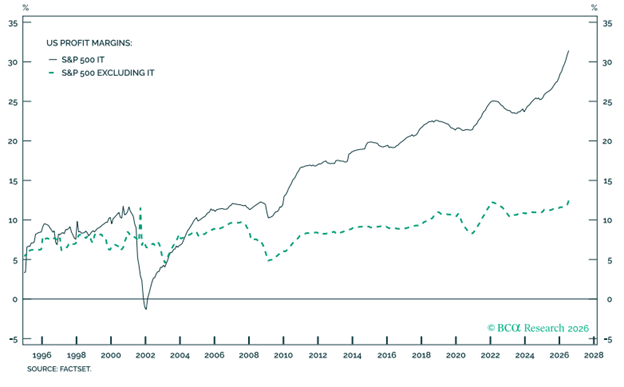
BCA notes that the surge in AI-related spending has helped drive a dramatic expansion in technology profits (chart below). Net income in the IT sector has nearly doubled over the past year, compared with roughly 20% growth outside of technology.
That makes sense. Somebody has to build the chips, data centers, networking equipment, and power infrastructure required to support AI. But there are two sides to every transaction.
For the companies selling that infrastructure, today’s spending is revenue. For the companies buying it, today’s spending is an investment that eventually has to generate a return. That distinction is becoming increasingly important.
Early in the AI cycle, investors understandably focused on how much companies were willing to spend. The numbers kept getting larger, which was great news for the companies supplying the infrastructure. The next phase of the story may be harder. Businesses actually using AI will eventually need to demonstrate that the productivity improvements, cost savings, and new revenue opportunities are large enough to justify all of the capital being committed today.
BCA is skeptical that today’s extraordinary growth rates and profitability can persist indefinitely. They point out that previous industry earnings booms have generally followed a familiar pattern: rapidly improving fundamentals attract capital, investment accelerates, and competition eventually erodes the excess returns.
That doesn’t mean AI is a bubble or that the technology won’t transform the economy. Those are two very different questions.
In fact, AI could ultimately live up to much of the excitement surrounding it while still producing disappointing investment returns for some of today’s winners. The internet changed virtually everything about how businesses operate. That didn’t mean every internet-related investment made in the late 1990s produced an attractive return.
The hurdle from here is simply getting higher.
Bottom Line: The first stage of the AI boom was about spending. The next stage will increasingly be about return on investment. AI can be transformative and today’s expectations can still prove too optimistic. Both things can be true at the same time.
3. Higher Rates Haven’t Broken the Expansion
With long-term interest rates rising and July’s employment report coming in much weaker than expected, it would be easy to conclude that the economy is beginning to roll over.
So far, the evidence isn’t quite there.
The labor market is certainly not as strong as it was a few years ago. Hiring has slowed and July payroll growth was particularly disappointing. But other indicators have been much more reassuring.
Ned Davis Research’s Employment Trends Index increased 0.9% in July, its first increase in three months and its largest gain since January. Five of the index’s seven components improved, including small-business job openings and initial unemployment claims. The index is also now slightly higher than it was a year ago after spending much of the past four years losing momentum.
Small businesses are telling a similar story. NFIB optimism rose to its highest level in nearly a year, while hiring plans improved to their strongest reading since October 2022.
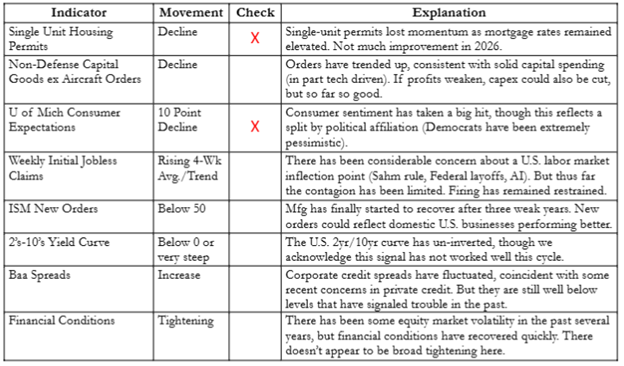
Credit markets aren’t flashing obvious warning signs either. Strategas Research Partners keeps a recession checklist (below), and currently, only two of eight indicators are triggered. Credit spreads remain well below levels historically associated with trouble, while broader financial conditions have generally recovered quickly following bouts of market volatility.
We think that last point matters quite a bit given what is happening in Treasury yields.
Higher interest rates aren’t inherently a problem for the economy or the stock market. They become much more concerning when they begin to restrict credit, weaken employment, and change the behavior of businesses and consumers.
Strategas makes essentially the same observation from a market perspective. Despite the move higher in yields, the market’s pro-cyclical tone has largely remained intact and credit has continued to behave reasonably well. Those are areas we would expect to weaken if higher rates were becoming truly disruptive.
For now, they’re not.
Bottom Line: The economy has slowed, but slowing and contracting are not the same thing. Higher interest rates deserve our attention, especially if they persist, but we believe the weight of the evidence continues to suggest an economy growing at a slower pace rather than one falling into recession.
Closing Thoughts
There is a tendency in investing to look for a single answer.
Are higher bond yields bearish? Is AI a bubble? Is the economy headed toward recession?
Markets rarely give us anything that clean.
Long-term interest rates have reached levels that deserve attention, but they have not yet caused meaningful deterioration in credit or economic activity. AI investment has produced enormous profits, but the companies spending that money will eventually have to prove that the investment was worthwhile. And the economy has clearly cooled, but most of the evidence still looks more consistent with moderation than contraction.
That is why we continue to focus on the weight of the evidence rather than any one headline.
There are legitimate risks building beneath the surface, particularly around interest rates and lofty expectations. But risks are not the same thing as outcomes. Until we see those risks begin to show up more broadly in earnings, credit, employment, and market trends, the backdrop remains more resilient than the headlines might suggest.