This week, Nick Amat, Senior Portfolio Designer, shares his investment insights for the week ahead.
Two things happened this month that are difficult to reconcile. Inflation stopped improving. The economy got stronger.
Neither was obvious from the headlines. July’s inflation report looked routine. Second-quarter growth looked soft. In both cases, the top-line number didn’t tell the whole story.
The market has noticed. Stocks and bond yields have started moving in opposite directions, which historically happens when investors are more concerned about inflation than they are encouraged by growth.
1. July Inflation: Cheaper Gas, Same Inflation Problem
July’s PCE report, the inflation gauge the Fed watches most closely, landed about where economists expected. Both the headline and core price indexes rose 0.2% on the month, leaving the year-over-year figures unchanged at 3.7% and 3.3%. Personal income and disposable income each rose more than forecast, and real spending was flat on the month but still up 2.4% from a year ago.
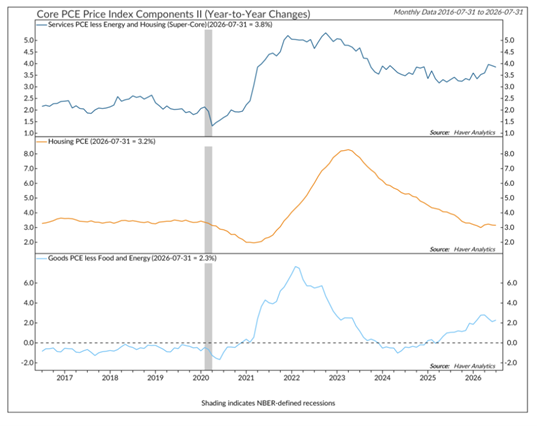
A quiet report with no real change in trend. The composition is where it gets interesting. Most of the relief since May has come from lower gasoline prices, and underneath that, the stickiest parts of the basket have barely moved. Three parts of the basket help explain why.
Super-core (3.8% y/y, down from 3.9%) — Services inflation excluding energy and housing. It has been slowly trending down but remains well above target, and has run above trend since the pandemic. Super-core is mostly labor-intensive services, which is why it has barely moved since the conflict in Iran began. It simply doesn’t respond to oil. Economists see eventual relief from rising productivity, including AI, but that could take several years.
Housing (3.2% y/y, steady) — Housing was a disinflationary tailwind coming out of the pandemic as rent spikes rolled out of the data. That tailwind is gone. PCE housing measures rent and owners’ equivalent rent across the entire stock of leases, most of which don’t reprice in a given month, and a housing shortage keeps a floor under rents. Neither changes quickly with oil prices or a Fed decision.
Core goods (2.3% y/y, up from 2.1%) — Core goods has trended closest to the Fed’s 2% target, but the point isn’t the level; it’s the direction. Goods was the disinflationary engine of 2023-24 and is the only one of the three now moving the wrong way, largely on tariffs and supply chain friction. It is also the component the Fed can least address with rate.
Bottom Line: This isn’t a warning that inflation is out of control. It’s a reminder that the parts of inflation still running hot have very little to do with oil. Cheaper gas won’t fix them, which we expect will likely keep inflation above the Fed’s 2% target. We believe the overall direction is still encouraging, but the pieces that are hardest to control are the ones left standing.
2. The Headline Understated the Quarter
The economy grew 1.5% last quarter after adjusting for inflation, down from 2.1% in the first quarter. Read in isolation, that looks like an economy losing steam. It wasn’t, for a few reasons.
First, the drag came from the least meaningful parts of the report. Trade flows and inventory swings subtracted nearly two full percentage points, and those line items bounce around every quarter without telling you much about the economy’s health. Strip them out and look at what households and businesses actually bought, and spending grew 4.2%, the strongest in more than three years.
Second, and more importantly, companies don’t get paid in inflation-adjusted dollars. They get paid in actual dollars. And in actual dollars, the economy grew 8.0% last quarter.
That gap is wider than the 3.7% inflation figure above because it measures something different: one quarter annualized rather than a full year, and every price in the economy rather than just what consumers pay. On that broader measure, prices rose at their fastest pace in four years.
The difference is bigger than it sounds. Inflation is a problem for consumers and the Fed, but it flows directly into corporate revenue. A quarter that looked mediocre on the headline was a good quarter for the businesses selling into it.
The profit numbers confirm it. Across every corporation in the country, not just the 500 in the S&P 500, profits rose 22.8% from a year ago, the fastest pace in five years. Profit margins economy-wide hit the widest level on record. That appears to reflect companies raising prices faster than their costs have risen.
Why profits tell you more than the growth number
Strong profits are one of the best cushions an economy has. We are not aware of a serious downturn beginning while corporate profits were still growing year over year, going back to the 1940s.
The logic isn’t complicated. Profitable companies keep spending, and they are. Business spending on equipment rose again in July, and June was revised higher. Business investment is still adding to growth rather than subtracting from it, the opposite of what happens heading into a recession. That describes conditions today, not what comes next, since profit data arrives late and gets revised heavily. But those conditions are not recessionary.
Not everything was strong. New home sales have cooled, particularly in the South, which carries more weight for national activity than any other region. With mortgage rates near 6.8%, housing is doing exactly what it is supposed to do when money is tight. It’s a real soft spot, and the clearest evidence that higher rates are working somewhere in the economy.
Bottom Line: Last quarter looked weaker than it was. Underlying demand was the strongest in three years, profits the best in five, margins hit a record, and businesses kept investing. That is not the profile of an economy running out of room. The complication is that the same strength driving profits is what’s keeping inflation elevated. For investors, that cuts two ways. Corporate earnings are the foundation under stock prices, and that foundation is solid, so a soft growth headline is not by itself a reason to get defensive. But an economy this resilient gives the Fed little reason to cut, which means relief on borrowing costs may take longer than many expect.

3. Stocks and Bonds Have Stopped Agreeing
Good news for the economy used to be good news for your portfolio. That link has broken.
For most of the past fifteen years, when interest rates rose, stocks rose with them. The logic was simple. Rates went up because the economy was getting stronger, and a stronger economy meant better corporate earnings.
That’s not what’s happening now. Over the past year, stocks and interest rates have moved in opposite directions more consistently than at almost any point since 1997. Rates up, stocks down.
Worth clarifying, since the title cuts both ways. When rates rise, existing bonds lose value. So stocks falling as rates rise means stocks and bonds are losing value together. What has stopped agreeing is the old link between a stronger economy and a stronger portfolio.
That flip is the story. When investors are focused on growth, rising rates are reassuring. When investors are focused on inflation, rising rates are threatening, because higher borrowing costs squeeze company profits and persistent inflation makes every future dollar of earnings worth less today. The market only trades one of those ways at a time, and right now it is trading the second one.
There is one practical consequence. With the 10-year Treasury near 4.7%, toward the upper end of its range over the past two decades, every sector of the S&P 500 now pays a dividend yield below what a Treasury bond pays. Bonds are a real alternative to stocks again rather than an afterthought. That doesn’t make stocks a bad investment, but the bar is higher. Strong earnings still support stock prices, and those earnings are now measured against a safe alternative paying more than it has for most of the past twenty years.
On the other side, higher rates aren’t all bad news. When bond yields rise on their own, they do some of the Fed’s tightening for it. Borrowing gets more expensive, the economy cools, and the Fed has less reason to raise rates itself. That’s a genuine offset, and part of why the Fed has been able to hold steady with inflation well above its target.
Bottom Line: The relationship between stocks and bonds has changed, and for most investors that is a bigger development than any single data point. When the two lose value at the same time, holding both cushions less than it used to. That is better to know before it happens than after. We believe what to watch isn’t the next inflation report or the next growth number. It’s whether stocks keep falling when rates rise.

Closing Thoughts
Two reports, neither of which looked remarkable on release, and a change in how the market is reading them. Together they describe an economy holding up better than expected and an inflation problem proving more durable than hoped.
That combination is uncomfortable without being alarming. Inflation improved, but for reasons we expect are unlikely to repeat. Growth was better than reported, but that strength is part of what’s keeping inflation elevated. And long-term rates have reached levels that deserve attention, though they have not yet produced meaningful deterioration in credit, employment, or earnings.
There are legitimate risks building beneath the surface, particularly around interest rates and elevated expectations. Risks are not the same thing as outcomes. Until they begin showing up more broadly in the data, the backdrop appears more resilient than the headlines suggest.