For much of this year, investors have been asking relatively straightforward questions. Would the economy avoid recession? Would inflation continue falling? Would corporate earnings remain strong?
Increasingly, the answers have been favorable. The economy has remained resilient, earnings have exceeded expectations, and stocks have continued reaching new highs.
But favorable answers have created a new set of questions.
Recent economic data suggest growth may actually be accelerating, even as inflation pressures reappear. Much of that inflation appears tied to supply constraints rather than an overheating labor market, making the Federal Reserve’s job more complicated. Meanwhile, the bull market continues to age, valuations remain elevated, and leadership beneath the surface is shifting.
None of that means the investment environment has turned bearish. It does mean the next phase may require more nuance than the last one.
Here are three themes we’re watching.
1. The Economy May Be Reaccelerating
For months, investors have debated how quickly the economy is slowing. Recent data raises a different possibility: perhaps it isn’t slowing much at all.
July’s ISM Manufacturing Index jumped to 55.6, its highest level since May 2022. The details were equally encouraging. Production strengthened, new orders remained firmly expansionary, and manufacturing employment expanded for the first time since September 2023.
The much larger services side of the economy is telling a similar story. The ISM Services Index remained comfortably above 50 in July, a level historically consistent with continued economic expansion.
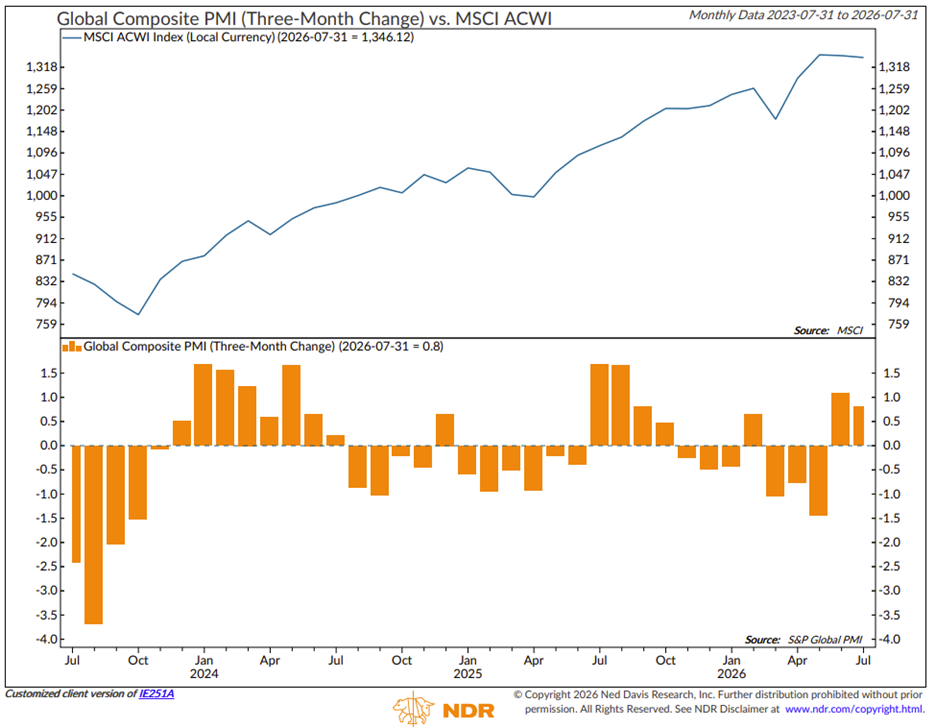
Importantly, this isn’t exclusively a U.S. phenomenon. The global composite Purchasing Managers’ Index rose for a fourth consecutive month to 52.6, its highest level in five months. New orders improved, employment strengthened, and business expectations continued to rise. Both global manufacturing and services remain in expansion territory.
That’s generally good news. Continued economic growth supports employment, consumer spending, and ultimately corporate profits. But there’s a catch.
A stronger economy also makes the Federal Reserve’s job more complicated, particularly if stronger activity is accompanied by renewed inflation pressure.
Bottom Line: The economic story may be shifting from resilience despite slowing toward renewed acceleration. That’s supportive for corporate fundamentals, but it reduces the likelihood that easier monetary policy will provide the next major tailwind.
2. Inflation Is Increasingly a Supply Problem
Normally, stronger economic activity accompanied by higher inflation would make the Federal Reserve’s response fairly straightforward: raise interest rates to slow demand.
Today’s situation isn’t quite that simple.
Price pressures have clearly increased. The ISM Services Prices Index climbed to 70.3, near its highest level since late 2022. Manufacturing prices are also elevated, while supply-chain pressures have increased considerably over the past six months.
But some of the traditional signs of an overheating economy are conspicuously absent.
The labor market remains relatively balanced. Job openings have fallen toward the number of unemployed workers, hiring remains subdued, and layoffs remain low, a backdrop Ned Davis Research describes as a “low hire, low fire” labor market.
More importantly, unit labor costs, the difference between what companies pay workers and how productive those workers are, are trending at just 1.6%. That’s dramatically different from the wage-price pressures experienced in 2021 and 2022 and doesn’t currently suggest significant second-round inflation pressure.
So where is the inflation coming from?
Increasingly, the evidence points toward the supply side. The Iran conflict and higher energy prices have disrupted supply chains, while enormous AI-related capital spending has created extraordinary demand for semiconductors, electricity, data center equipment, and other scarce resources. NDR notes that income and wage growth themselves don’t appear excessive enough to explain today’s inflation pressure.
That distinction matters because interest rates are a relatively blunt instrument.
The Federal Reserve can make borrowing more expensive and reduce demand. It cannot produce more oil, manufacture additional semiconductors, or immediately expand electrical generating capacity.
Bottom Line: Inflation remains a legitimate risk, but its source matters. We believe today’s inflation looks less like an economy experiencing excessive wage-driven demand and more like a growing economy colliding with supply constraints. That makes the Fed’s policy decisions, and the market’s reaction to them, more complicated.

3. The Bull Market Is Old. That Doesn’t Mean It’s Over
There is no getting around one fact about today’s market: this has been a remarkably long run.
The secular bull market that began in 2009 is now the second-longest of the five secular bull markets since 1900. The cyclical bull that began in 2022 is also the sixth-longest of 39 cyclical bulls over that period. That naturally raises the question: are we approaching the end?
There are legitimate reasons for caution.
Valuations are historically elevated. Investor exposure and optimism have increased. Bond yields and commodity prices have been trending higher. U.S. stocks have also begun to lose some relative strength to international markets, historically one characteristic associated with changing secular leadership.
But those are warning signs, not confirmation.
NDR keeps tabs on several indicators to warn of a secular bear, and they still conclude that the secular bull remains intact. The evidence we’d expect to see if a true secular bear had begun simply isn’t there yet. Real and nominal equity returns remain strongly positive, and the S&P 500 has reached record highs on 49 separate days over the past year.
That’s an important distinction.
Markets don’t turn bearish because they’ve reached a certain age. They turn bearish when the underlying evidence deteriorates.
For now, long-term breadth remains healthy despite considerable rotation beneath the surface. NDR notes that sector and style rotations throughout 2026 have actually helped prevent longer-term breadth indicators from turning bearish.
That doesn’t mean investors should ignore elevated valuations, higher rates or shifting leadership. Those risks become increasingly important as a bull market matures.
It simply means maturity shouldn’t be confused with mortality.
Bottom Line: This is an old bull market, and several indicators deserve closer attention. But the evidence that has historically confirmed the beginning of a secular bear hasn’t arrived. Until it does, we believe the better approach is to remain invested while emphasizing diversification and discipline rather than attempting to predict the exact date the cycle ends.

Final Thoughts
There is an interesting contradiction running through today’s markets.
The economy is strengthening. Corporate earnings remain exceptionally strong. The global expansion continues. And the long-term market trend remains positive.
Yet each of those positives comes with a qualification.
Stronger growth can keep inflation elevated and monetary policy restrictive. AI investment is supporting economic activity but simultaneously placing pressure on scarce resources. And years of strong market returns have pushed valuations and investor expectations considerably higher.
We don’t view those crosscurrents as evidence that the bull market is ending. We view them as evidence that it is maturing.
Earlier in this cycle, simply avoiding recession and falling inflation were enough to create positive surprises. Going forward, returns may depend increasingly on sustained earnings growth, productivity improvements and the economy’s ability to expand without creating persistent inflation. But today’s backdrop remains constructive.